
Outsource or In-house? Who Should Build Your Software
The short answer: build the product at the core of your business in-house, and hand everything else to a reliable partner.
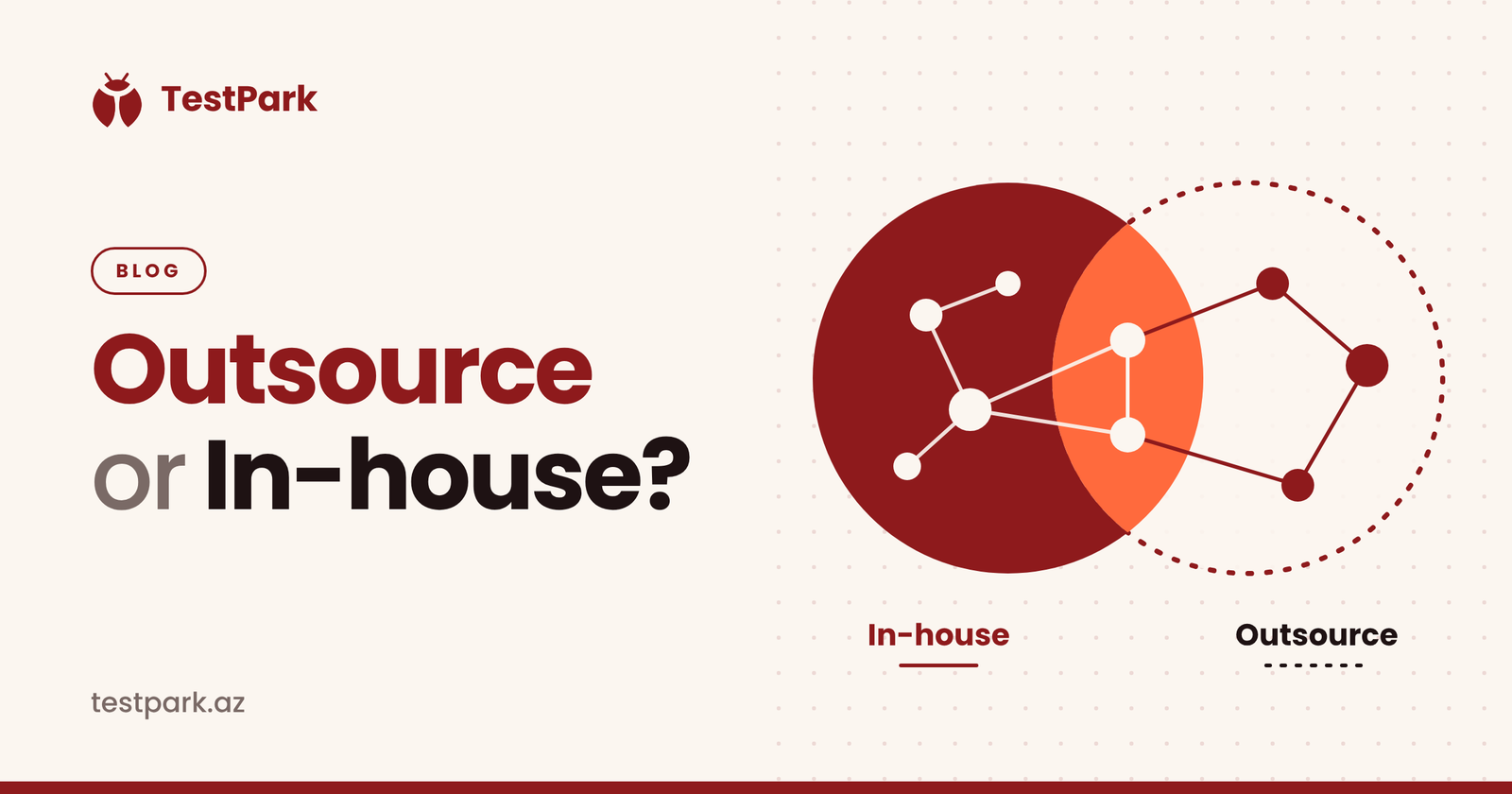
The short answer: build the product at the core of your business in-house, and hand everything else to a reliable partner. For most companies, the most cost-effective path is a combination of the two.
When you need a new mobile app, an internal management system or an AI solution, every leader faces the same question: do we build our own team, or give the work to an outside company? The wrong choice means months of lost time and a serious hit to the budget. In this post we share the strengths and weaknesses of both models, their hidden costs, and five questions that make the decision easier.
In-house: your own team
The In-house model gives you full control over the product and deep business knowledge, but it is the most expensive path and the slowest to start. The team works inside the company and lives the product, the customer and the processes every day.
Advantages
Full control. You set the priorities, the technology and the pace of work.
Knowledge stays in the company. Product experience builds up over the years and turns into a competitive advantage.
Fast internal communication. Asking a question does not require a contract or a scheduled meeting.
Cultural fit. The team treats the company's goals as its own.
Hidden costs
Hiring takes time. Finding a good engineer, QA specialist or designer can take months.
Salary is only part of the cost. Taxes, equipment, licenses, office space, training and management all add to the budget.
Idle time risk. When the project ends, the team's salaries do not.
Staff turnover. When a key specialist leaves, the knowledge leaves with them.
Narrow expertise. A small team cannot cover performance testing, security, AI and every other field.
When it is the right choice: software is the core product of your business, the work is long-term and continuous, and you have a stable budget to keep the team.
Outsource: an external partner
The Outsource model gives you speed, flexibility and ready-made expertise; in return, it demands more attention to partner selection and communication. A specialized company does the work with its own team, processes and tools.
Advantages
Fast start. A ready team begins within weeks, with no hiring phase.
Predictable cost. You pay only for the work done, and when the project ends, so does the cost.
Broad expertise. An analyst, designer, developer, QA and AI specialist are all at hand under one contract.
Scalability. It is easy to grow or shrink the team to match the stage of the project.
An outside view. A team that has seen dozens of different projects quickly spots the risks you do not see.
Risks
Communication gaps. If requirements are not written clearly, the result will differ from what you expected.
Dependency. If the code, documentation and access are not in your hands, changing partners gets harder.
Quality gap. The cheapest offer on the market often turns out to be the most expensive.
Confidentiality. Data and intellectual property matters must be spelled out in the contract.
When it is the right choice: the project has a clear beginning and end, you need to reach the market quickly, the work requires skills you do not have in-house, or software is not your core business.
Five questions before you decide
Your answers to these five questions often make the choice for you.
1. Does this software set you apart from competitors? If yes, the knowledge should stay inside. If no, give it to a team that does it better than you.
2. How long will the work last? Building a team for a three-to-six-month project does not pay off. Development that will go on for years justifies an in-house team.
3. How quickly do you need results? If time is the main factor, the months spent on hiring are the biggest loss.
4. Do you have the skills required? Work such as load testing, a security audit or AI integration is needed a few times a year. Keeping full-time staff for it is a waste.
5. Do you have someone to manage the team? Without a technical lead, neither an in-house team nor an external partner delivers good results. Even with Outsource, there must be one responsible person on your side who makes decisions.
The hybrid model: the best of both
In practice, the best result comes not from "either-or" but from combining the two. A small in-house core keeps the product direction and business knowledge, while an external partner handles execution and the work that needs specialized skills.
Three common scenarios:
In-house product owner + external development team. Decisions stay with you, execution with the partner.
In-house developers + independent testing. The team that writes the code struggles to see its own mistakes. An external QA team checks the product through the user's eyes.
In-house team + temporary reinforcement. Extra specialists join during busy periods or a move to a new technology.
The hybrid model works on three conditions: the code and documentation must be your property, the division of responsibility must be in writing, and both sides must work in the same tools and at the same rhythm.
Conclusion
The right question is not "outsource or in-house?" but "who should do which work?". Keep what sets you apart in your own hands, and for the rest, work with a partner who brings speed and expertise.
At TestPark we know both sides. We build JobPark, EventPark and Olsa.live with our own team. At the same time, we run and manage the whole process for our clients, from analysis and design to development and testing.
Let's work out together which model fits your project: book a meeting at testpark.az or call +994 55 587 70 87.